

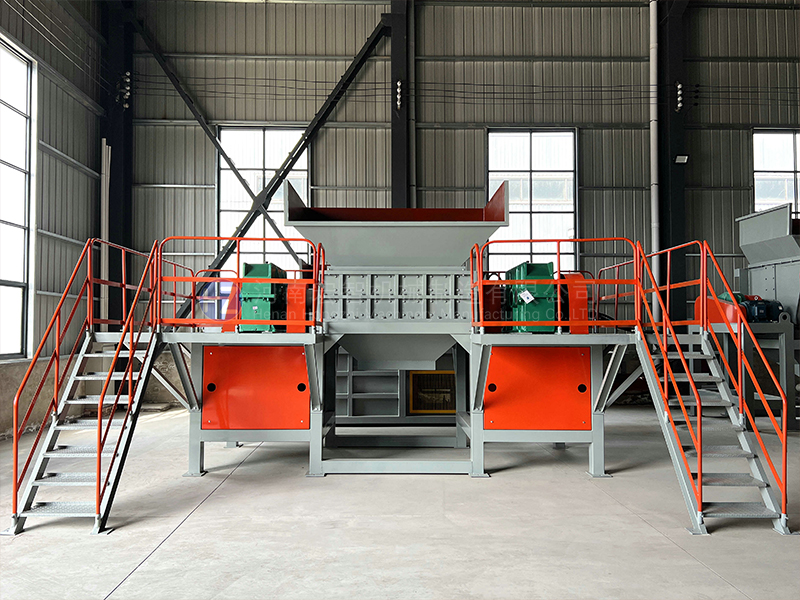
If you are searching for RDF forming machine user-approved manufacturers, suppliers, and exporters recommendations,
this guide is designed to help you evaluate the market with confidence. RDF forming machine selection is a critical step for
waste processing plants, refuse-derived fuel production lines, municipal solid waste recycling facilities, and alternative fuel
manufacturing operations. Instead of focusing on specific companies, this page provides industry-standard information
that supports informed purchasing decisions, product comparison, and SEO-friendly content development for blogs, catalog pages,
and industrial service directories.
RDF, or Refuse Derived Fuel, is a processed fuel produced from waste materials through sorting, shredding,
drying, screening, and densification. An RDF forming machine plays a central role in converting prepared waste fractions into
consistent fuel shapes such as pellets, briquettes, or compacted blocks. These forms improve storage efficiency, transportation
handling, combustion stability, and end-user acceptance. For buyers, exporters, and project developers, understanding the
machine’s working principle, technical specifications, performance advantages, and supplier evaluation criteria is essential.
An RDF forming machine is industrial equipment used to compress prepared refuse-derived fuel materials into
uniform and manageable fuel formats. It is typically installed after the pre-processing stage, where waste is sorted to remove
metals, glass, inert materials, and moisture-rich fractions. The machine applies pressure, sometimes with heat or binders,
to shape the RDF feedstock into a dense and marketable fuel product.
RDF forming machines are used in waste-to-energy plants, solid fuel preparation facilities, environmental engineering projects,
and industrial fuel production lines. Depending on the design, the machine may produce pellets, briquettes, logs, or blocks.
The main purpose is to improve fuel consistency and make alternative fuel easier to store, transport, and burn in industrial
boilers, cement kilns, and thermal systems.
The demand for alternative fuels continues to rise as industries seek lower-cost and lower-emission energy options. RDF forming
machines help convert mixed waste streams into usable fuel, supporting circular economy goals and reducing landfill dependence.
Their role becomes increasingly important when municipalities and industrial operators look for scalable methods to manage waste
and recover value from non-recyclable materials.
In many regions, the market for RDF equipment is driven by environmental regulation, landfill cost pressure, energy diversification,
and the need for local fuel solutions. A well-designed RDF forming machine can help operators standardize production quality,
reduce material loss, and create a more commercial product for downstream customers.
Although designs vary, the general working principle of an RDF forming machine is straightforward. First, pre-processed RDF feedstock
is delivered into the hopper or feeding system. Then the machine compresses the material under mechanical force, often assisted by
a die, roller, screw, piston, or press structure. The compressed material exits in a defined shape depending on the equipment type.
The workflow commonly includes:
In high-quality production lines, the forming stage is integrated with upstream and downstream systems to ensure stable output,
reliable density, and consistent fuel characteristics.
The global RDF equipment market includes different forming technologies. Each type serves specific production needs, material
characteristics, and output requirements. Buyers should compare machine type, throughput, maintenance requirements, and final fuel
shape before making a procurement decision.
| Machine Type | Typical Output Form | Main Feature | Best For |
|---|---|---|---|
| RDF Briquette Press | Briquettes | High compaction and stable shape | Industrial fuel users, storage efficiency |
| RDF Pelletizing Machine | Pellets | Uniform small-size fuel | Automated feeding systems, boiler fuel |
| RDF Block Press | Blocks | Large compact fuel units | Heavy-duty handling and transport |
| Hydraulic RDF Press | Briquettes or blocks | Strong pressure with simple structure | Stable density and basic maintenance |
| Screw Extrusion Forming Machine | Continuous fuel logs | Continuous output with good forming stability | Continuous production lines |
RDF forming machines offer a wide range of operational and commercial advantages. These benefits make them valuable in waste
treatment systems, energy recovery facilities, and fuel preparation businesses.
| Advantage | Description | Operational Benefit |
|---|---|---|
| Improved Density | Compresses loose waste-derived material into denser fuel products | Better storage and lower transport cost |
| Uniform Fuel Shape | Produces consistent size and form | More stable feeding and combustion |
| Reduced Volume | Significantly decreases material bulk | More efficient logistics and warehouse use |
| Enhanced Fuel Value | Improves usability as industrial alternative fuel | Better market acceptance |
| Waste Diversion | Supports landfill reduction and resource recovery | Environmental compliance and sustainability |
| Automation Compatibility | Can be integrated into automated fuel lines | Higher efficiency and lower labor dependency |
RDF forming machines are used across multiple industrial sectors. Their applications continue to expand as more companies seek
practical solutions for waste valorization and fuel production.
When reviewing RDF forming machine suppliers and exporters, technical specifications should be analyzed carefully. The right
machine depends on the material composition, target output, desired capacity, and installation environment.
| Specification | What It Means | Why It Matters |
|---|---|---|
| Production Capacity | Amount of RDF output per hour | Determines line size and project feasibility |
| Output Shape | Pellet, briquette, block, or log | Must match customer and combustion requirements |
| Motor Power | Electrical energy used by the machine | Influences performance and operating cost |
| Compression Method | Hydraulic, mechanical, screw, or piston | Affects density and forming consistency |
| Feedstock Moisture Range | Acceptable moisture level for operation | Impacts material flow and final quality |
| Machine Material | Steel grade and wear resistance | Determines durability and service life |
| Automation Level | Manual, semi-automatic, or automatic control | Influences labor requirements and ease of use |
| Maintenance Access | Ease of cleaning and part replacement | Reduces downtime and repair cost |
Buyers often search for user-approved manufacturers, suppliers, and exporters because reputation and practical
performance matter more than promotional claims. Since this page does not recommend specific companies, the most useful approach
is to evaluate vendors using objective criteria that reflect real-world operating conditions.
Key evaluation factors include production experience, technical support, export capability, manufacturing quality, spare parts
availability, and after-sales service. Reliable suppliers should be able to explain machine structure, material compatibility,
expected output, installation requirements, and maintenance procedures in clear terms.
| Evaluation Factor | What to Look For | Buyer Priority |
|---|---|---|
| Industry Experience | Proven background in RDF or waste processing equipment | High |
| Custom Engineering | Ability to adapt machine design to feedstock and output goals | High |
| Product Quality | Strong frame, wear-resistant parts, stable operation | High |
| Export Documentation | Ability to provide shipping, customs, and technical documents | Medium to High |
| Installation Support | Guidance for setup, commissioning, and training | High |
| After-Sales Service | Spare parts, troubleshooting, and remote assistance | High |
| Lead Time | Reasonable production and delivery schedule | Medium |
| Pricing Transparency | Clear quotation structure and optional accessories | High |
A high-quality RDF forming machine usually includes a combination of structural and functional features that improve reliability,
safety, and output stability. These features may vary by model and manufacturer, but certain design elements are common across
the industry.
The quality of the input material strongly influences final product performance. RDF forming machines generally work best with
pre-treated feedstock that has already been sorted and size-reduced. High contamination levels, excess moisture, and oversized
particles can reduce efficiency and compromise output quality.
Common RDF input materials may include:
Feedstock characteristics should be reviewed before machine selection to ensure stable forming performance and consistent fuel
quality.
RDF forming machines are frequently traded internationally because many countries are investing in waste management and
alternative fuel development. Export-focused buyers often prioritize robust construction, simple operation, spare part
availability, and compatibility with local voltage and standards.
For exporters, success in this market depends on clear technical communication, flexible packaging, documentation support, and
the ability to serve diverse customer requirements. As RDF systems vary by region, machine suppliers that understand export
logistics and customization tend to have stronger market appeal.
For content optimization, the following keyword variations are commonly associated with RDF forming machine topics. These terms
can help improve search visibility when used naturally in blog articles, product category pages, and industry resource pages.
Before purchasing RDF forming equipment, buyers should define production targets, input material conditions, available plant space,
power supply, and project budget. The best machine is not always the largest or most expensive one; it is the one that aligns
with the actual feedstock and operating goals of the facility.
Important questions to ask include:
In professional RDF production, performance is judged by density, durability, output consistency, power consumption, and operating
stability. A good RDF forming machine should maintain stable shaping under load, minimize downtime, and support predictable
production conditions. Many buyers also consider safety design, noise level, machine footprint, and ease of cleaning.
The following table summarizes common performance criteria:
| Performance Criterion | Desired Outcome | Industry Importance |
|---|---|---|
| Fuel Density | Higher density for efficient handling | Very High |
| Shape Consistency | Uniform output size and form | Very High |
| Output Stability | Continuous and reliable production | Very High |
| Energy Efficiency | Lower electricity use per ton | High |
| Wear Resistance | Long service life of key parts | High |
| Ease of Operation | Simplified control and monitoring | High |
The market for RDF forming machine user-approved manufacturers, suppliers, and exporters recommendations continues
to expand as industries search for reliable waste-to-fuel solutions. While this guide does not list specific companies, it gives
a strong foundation for understanding RDF forming technology, technical specifications, advantages, applications, and vendor
evaluation methods.
For blog publishing, directory pages, and industrial SEO content, this type of structure helps attract relevant search traffic
while offering genuine value to readers. By focusing on RDF forming machine definitions, machine types, advantages, specifications,
and procurement criteria, businesses can create content that is both informative and search-engine friendly.


No. 18, South Road, 30 Meters West
Of The Intersection Of Guhuang Line And 010
Township Road In Xiangyun Town, Wen County, Jiaozuo, Henan, China


info@hzwastesorting.com

+86 19639126087
Copyright © 2025 Henan Hongzhi Machinery Manufacturing Co.,Ltd. All rights reserved.
SitemapThis website uses cookies to ensure you get the best experience on our website.

 España
 Portugal
 Russian
 عربي



 Phone
Comment
(0)