

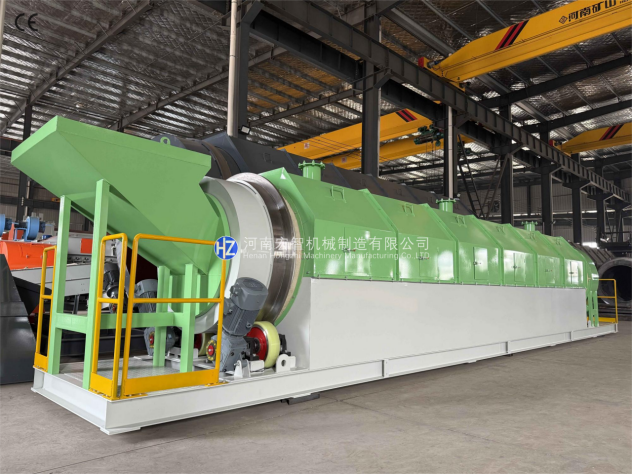
Industrial eddy current sorting equipment has become a critical solution for businesses that need fast, accurate, and non-ferrous metal separation in modern recycling, waste processing, mining, and manufacturing operations. For buyers searching for industrial eddy current sorting equipment, the focus is usually on performance, throughput, separation precision, durability, maintenance efficiency, and the ability to scale for wholesale or export applications. This guide provides original, SEO-friendly, English-only industry content designed for blog pages, category pages, landing pages, and directory pages. It contains general market information, definitions, working principles, advantages, technical specifications, application fields, selection criteria, and procurement guidance without naming any specific company.
If you are comparing best wholesale manufacturers and exporters of industrial eddy current sorting equipment, this page will help you understand the equipment category, identify the right technical parameters, and evaluate product quality and supplier capability from an expert perspective. The content is structured to support search engine indexing, keyword relevance, and user engagement.
Industrial eddy current sorting equipment is a type of metal separation system used to recover and separate non-ferrous metals from mixed material streams. It is widely used in recycling plants, waste sorting facilities, scrap processing centers, mineral recovery operations, and industrial production lines. The machine works by using a rapidly rotating magnetic field to induce eddy currents in conductive non-ferrous metals such as aluminum, copper, brass, and some stainless steel grades. These induced currents create a repelling force that separates target metals from non-metallic or weakly conductive materials.
In simple terms, eddy current sorting equipment helps industries recover valuable non-ferrous metals from mixed waste and raw material streams with high efficiency. Because the process is continuous, non-contact, and highly automated, it is one of the most effective technologies for modern metal recovery and sorting operations.
The global demand for industrial eddy current sorting equipment has grown significantly due to rising recycling rates, tighter environmental regulations, and increasing metal recovery targets. Wholesale buyers and exporters often look for equipment that offers stable production performance, easy integration, strong return on investment, and long service life. In many markets, non-ferrous metal recovery is no longer optional; it is a key profitability factor for recycling and waste management businesses.
For wholesale channels, the equipment must also meet international expectations for quality consistency, packaging, shipping efficiency, replacement parts support, and compliance with local safety and electrical standards. Export-ready eddy current separators typically require robust design, adjustable configuration, and documentation suitable for cross-border trade. That is why buyers often search for the best wholesale manufacturers and exporters recommended by experts, even when they are only collecting general market information.
Industrial eddy current sorting equipment operates through the interaction of a Conveyor belt, a high-speed magnetic rotor, and a separating mechanism. Material is fed onto the belt and moved toward the head pulley, where the magnetic rotor generates an alternating magnetic field. Conductive non-ferrous particles experience induced eddy currents that create a magnetic repulsion effect. As a result, these particles are projected away from the normal material trajectory, while non-conductive materials continue along a different path.
The separation process depends on several factors, including particle size, conductivity, density, shape, belt speed, rotor speed, pole count, and feed consistency. Proper equipment configuration is essential for achieving high sorting purity and maximum recovery efficiency.
Industrial eddy current sorting equipment is used in many sectors where non-ferrous metal recovery is important. Typical applications include:
In each of these applications, the main goal is to remove valuable non-ferrous metals from a mixed stream while maintaining a high throughput rate. This makes eddy current sorting equipment a valuable asset in industrial recycling and export-oriented processing operations.
Buyers and operators choose eddy current sorting technology for several strong reasons. Below are the main advantages of industrial eddy current sorting equipment:
| Advantage | Description | Business Value |
|---|---|---|
| High separation efficiency | Effectively separates conductive non-ferrous metals from mixed materials. | Improves metal recovery rate and revenue. |
| Continuous operation | Designed for nonstop feeding and high-volume processing. | Supports industrial-scale throughput. |
| Non-contact sorting | Uses magnetic force without physical contact with the material. | Reduces wear and contamination risk. |
| Low maintenance demand | Fewer moving parts than many mechanical sorting systems. | Reduces downtime and maintenance costs. |
| Energy-efficient performance | Optimized motors and rotor systems consume less power per unit output. | Lowers operational expenses. |
| Wide material compatibility | Suitable for aluminum, copper, brass, and other non-ferrous materials. | Flexible use across multiple industries. |
| Automation-friendly design | Can be integrated into automated recycling and sorting lines. | Improves labor efficiency and process consistency. |
These benefits make industrial eddy current sorting equipment one of the most attractive investments for recycling plants and material recovery facilities. For wholesale buyers, the technology is also appealing because it can be packaged into scalable product lines for different processing capacities.
When comparing industrial eddy current sorting equipment, buyers usually review a combination of mechanical, electrical, and operational specifications. These details help determine whether the equipment is suitable for a specific production line, waste stream, or export market.
| Specification Item | Typical Consideration | Why It Matters |
|---|---|---|
| Belt width | Commonly selected based on material volume and particle size | Directly affects throughput capacity |
| Belt speed | Adjustable in many models | Influences sorting precision and trajectory |
| Rotor speed | Determines magnetic field rotation intensity | Critical for separation performance |
| Magnetic pole design | Number and arrangement of poles vary by machine | Impacts sorting effect on different particle sizes |
| Feed size range | Fine, medium, or coarse material compatibility | Ensures stable operation |
| Motor power | Matched to equipment size and throughput | Determines drive capability and energy use |
| Frame material | Heavy-duty steel structures are common | Affects durability and service life |
| Control system | Manual or PLC-based automation | Improves operational convenience and precision |
| Discharge separation design | Splitter positions and collection channels | Influences recovery purity |
| Dust and wear protection | Sealed bearings, covers, and protective liners | Extends lifespan in harsh environments |
Wholesale and export markets often classify industrial eddy current sorting equipment by design, size, and intended application. Although product details vary across suppliers, the following categories are common in the industry:
| Equipment Type | Main Feature | Common Use |
|---|---|---|
| Standard eddy current separator | General-purpose non-ferrous metal recovery | Recycling plants and scrap sorting lines |
| High-speed eddy current separator | Enhanced rotor performance for difficult separation | Fine materials and mixed waste streams |
| Large-capacity separator | Designed for high-volume industrial feeding | Large recycling facilities and export projects |
| Compact separator | Space-saving design for smaller lines | Laboratories, pilot plants, and smaller operations |
| Customized sorting system | Configured to client specifications | Special industrial processes and OEM projects |
Since this page does not recommend any specific company, it is useful to understand the general criteria that experts use when evaluating industrial eddy current sorting equipment wholesale manufacturers and exporters. These criteria help buyers identify reliable suppliers in the global market.
In general, the best wholesale manufacturers and exporters are not only those with low prices, but those that can provide stable quality, export support, and repeatable sorting performance over long-term use.
Choosing the right eddy current sorting equipment requires more than just comparing price. Buyers should study the feed material, required recovery rate, target metal types, and available installation space. A suitable machine should be matched to the actual production environment rather than selected only by nominal capacity.
| Selection Factor | Questions to Ask | Buying Tip |
|---|---|---|
| Material composition | What percentage of non-ferrous metal is present? | Choose a model designed for your actual stream. |
| Particle size | Are the materials fine, medium, or coarse? | Ensure the feed size matches the separator design. |
| Throughput requirement | How many tons per hour are needed? | Select sufficient belt width and motor power. |
| Sorting purity | Is maximum purity or maximum recovery the priority? | Optimize settings according to your business goal. |
| Space availability | How much floor space and height is available? | Check machine dimensions before ordering. |
| Automation level | Do you need manual or fully automated control? | Choose the control system that fits your operation. |
| Maintenance access | Can operators easily inspect and clean the system? | Maintenance-friendly layouts reduce downtime. |
A proper selection process helps improve return on investment and prevents underperforming equipment from becoming a bottleneck in the sorting line.
Industrial eddy current sorting equipment should be installed on a stable foundation with proper alignment, safe power supply, and adequate space for maintenance access. Correct installation is essential for smooth belt tracking, accurate separation, and low vibration. During startup, operators should verify feed consistency, rotor direction, speed settings, and discharge split positions.
During operation, the machine should be monitored for belt wear, magnetic rotor cleanliness, bearing condition, and material overload. Stable feeding improves separation performance and helps avoid product contamination. Regular inspection and preventive maintenance can extend equipment life and reduce operating costs.
Like any industrial machine, eddy current sorting equipment performs best when maintained properly. A well-planned maintenance schedule supports continuous operation and protects the investment.
Preventive maintenance is especially important in wholesale and export applications where equipment may run under high load for long hours. Reliable maintenance procedures help preserve sorting accuracy and throughput over time.
One of the strongest reasons for buying industrial eddy current sorting equipment is the potential to increase recycling profitability. By recovering high-value non-ferrous metals from waste streams, operators can create an additional revenue source and improve the value of processed material. Even small recovery improvements can have a significant financial impact in large-volume operations.
In many plants, eddy current sorting is used as a secondary or final step after shredding, screening, or magnetic separation. This improves the overall recovery chain and reduces the amount of valuable metal sent to landfill or low-value waste streams. For export markets, this is particularly important because buyers often expect strong material recovery performance and efficient operating economics.
The industrial eddy current sorting equipment market continues to evolve with advances in automation, control systems, and material handling design. Current trends include higher efficiency rotors, improved wear-resistant components, modular structures, and smarter control interfaces. Buyers also increasingly prefer machines that are easier to ship, install, and integrate into existing lines.
Another important trend is customization for specific waste streams. Rather than using a one-size-fits-all approach, many wholesale manufacturers and exporters now offer application-based configurations for aluminum recovery, shredder residue sorting, e-waste processing, and construction waste recycling. This makes equipment selection more precise and helps improve separation results.
It is primarily used for non-ferrous metals such as aluminum, copper, brass, and similar conductive materials. The exact performance depends on particle size, conductivity, and machine settings.
Yes. Industrial eddy current sorting equipment is widely traded in wholesale and export markets because it can be configured for different capacities, electrical standards, and industrial applications.
Maintenance needs are generally moderate. Regular inspection, cleaning, belt adjustment, and lubrication are usually sufficient to maintain good performance.
Many industrial models can be customized in belt width, rotor design, discharge layout, control system, and frame structure to suit specific production requirements.
Recycling, scrap processing, waste management, mining, and industrial recovery operations are the most common users of eddy current sorting equipment.
Industrial eddy current sorting equipment is a high-value solution for non-ferrous metal recovery, recycling efficiency, and industrial sorting automation. It offers strong separation performance, continuous operation, low maintenance, and wide application potential across recycling and processing industries. For buyers seeking the best wholesale manufacturers and exporters, the most important evaluation factors are quality, capacity, customization, export readiness, and long-term service support.
Whether used in a recycling plant, waste processing facility, or export project, industrial eddy current sorting equipment remains one of the most effective technologies for separating conductive non-ferrous metals from mixed material streams. A carefully selected machine can improve throughput, increase recovery value, and support sustainable industrial operations.


No. 18, South Road, 30 Meters West
Of The Intersection Of Guhuang Line And 010
Township Road In Xiangyun Town, Wen County, Jiaozuo, Henan, China


info@hzwastesorting.com

+86 19639126087
Copyright © 2025 Henan Hongzhi Machinery Manufacturing Co.,Ltd. All rights reserved.
SitemapThis website uses cookies to ensure you get the best experience on our website.

 España
 Portugal
 Russian
 عربي



 Phone
Comment
(0)